GD-Workshop
Redesigning a learning platform to turn interest into enrollment — by making student outcomes the proof, not marketing promises.
Role:
Product Designer (end-to-end)
Scope:
Research, UX, UI, Design System
Markets:
Saudi Arabia
The impact in numbers
+22%
Higher enrollments
+31%
Deeper engagement
-18%
Fewer drop-offs
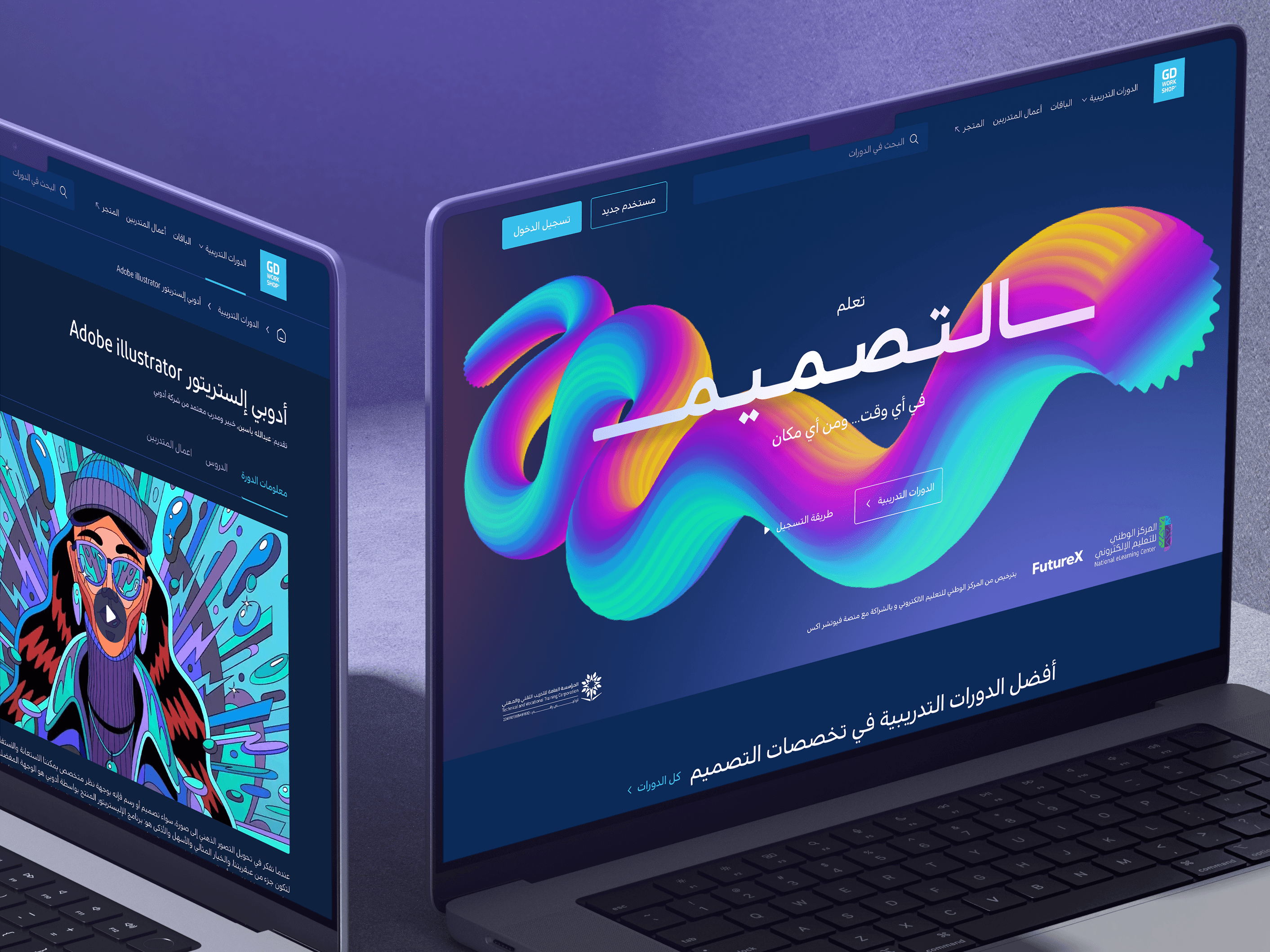


Overview — Designing clarity that converts
GD-Workshop offers high-quality, instructor-led creative programs. The platform had strong content and talented instructors, but the website wasn't translating that into enrollments. Visitors would browse programs, show interest, but hesitate to commit—uncertain about what they'd actually learn, what the experience would look like, or whether the investment was worth it.
I was brought in as a product designer to redesign the full website experience—from initial audit through a new design system to the final UI. The goal was clear: turn a marketing-heavy site into an evidence-led enrollment experience that helps prospective learners make confident decisions.
The challenge — When good programs don't sell themselves
The existing website had two core problems working against it:
Visitors couldn't see the value
Program pages described what was taught, but not what students actually achieved. The information was abstract — course outlines and instructor bios without tangible evidence of outcomes. A prospective learner had to take the site's word for it rather than see proof.
The experience was visually fragmented
As GD-Workshop grew and added programs, the website became inconsistent across pages. Layouts, typography, CTAs, and content modules varied from page to page, creating cognitive load that made it harder for users to focus on the decision that mattered: should I enroll?
The result was a site that worked as a brochure but failed as a conversion tool. Users who were already interested were losing confidence at the exact moment they needed it most.

The Process: Turning insight into action
Step 1
Auditing what wasn't working
Before redesigning anything, I audited the existing site to understand where and why users were dropping off. I reviewed page structure, content hierarchy, and the overall user flow from landing on the site to reaching an enrollment decision
The audit revealed a critical insight: GD-Workshop had an incredible asset that was almost invisible — student work. Real projects created by real students were buried in a secondary gallery that most visitors never found. This was the strongest proof of program quality, and it was hidden behind layers of marketing copy.
Other issues included
Program pages were led with course descriptions rather than outcomes, forcing users to read through everything before understanding what they'd actually gain.
There was no consistent structure across program pages — each was laid out differently, making comparisons difficult and slowing decision-making.
CTAs were inconsistent in placement and language, creating friction at the exact moments when users were ready to act.
Step 2
Elevating student work as the decision driver
The biggest design decision was repositioning student work from a secondary gallery to a core element of the enrollment experience. Instead of telling prospective learners how good the programs were, the redesign let them see it for themselves.
Student projects were integrated directly into program pages — placed alongside course structure and outcomes so that a visitor could immediately connect "here's what you'll learn" with "here's what students actually produced." This shifted the experience from explanation to evidence.
The content strategy was restructured around three questions every prospective learner asks:
What will I learn? — Program structure and expectations, presented clearly and concisely.
What will I be able to do? — Real student work as tangible proof of outcomes.
Is it worth it? — Transparent information about effort, time commitment, and what to expect.
By answering these questions visually and directly, the site removed the guesswork that was causing hesitation.


Step 3
Building a system for consistency
With the content strategy defined, I designed a complete design system and component library to standardize the experience across the entire site.
The system included
Standardized page layouts for program pages, ensuring every program presented information in the same clear structure — outcomes first, then details, then enrollment.
A component library covering program cards, student work showcases, instructor profiles, CTAs, and testimonial modules — all reusable and consistent.
Typography and spacing rules that reduced visual noise and helped users focus on content rather than deciphering different page designs.
Consistent CTA patterns — same language, same placement, same visual weight across every page, reducing friction at decision points.
This system didn't just solve the visual fragmentation — it created a foundation that GD-Workshop could build on as they added new programs without the experience degrading over time.
Step 4
Designing and testing the new experience
With the system in place, I designed the new UI across all key pages — homepage, program listings, individual program pages, and student work showcases.
The design focused on reducing cognitive load at every step. Information was layered so that a quick scanner could get the key message in seconds, while a deeper reader could explore details without feeling overwhelmed. Visual hierarchy guided the eye from program value to student proof to enrollment action — a deliberate flow designed to build confidence progressively.
I tested the designs with prospective learners to validate that the new structure made the decision easier. Key iterations based on testing:
Student work was moved higher on program pages after testing showed users needed to see it before reading detailed course content.
Program expectations and time commitment were made more explicit after feedback showed users wanted to know what was required of them before enrolling.
CTA language was refined from generic "Apply Now" to more confidence-building language that matched where users were in their decision process.


The impact in numbers
+22%
Higher enrollments
More visitors converted to enrolled students, proving that making outcomes visible directly drives decisions.
+31%
Deeper engagement
Engagement on program pages increased, with users spending more time with content that mattered and less time bouncing between pages.
-18%
Fewer drop-offs
Users moved through the enrollment flow with fewer drop-offs and less hesitation at key decision points.

When clarity turns into commitment
The redesign proved a simple principle: when you stop trying to persuade people and start showing them evidence, decisions become easier. By making student work the centerpiece, structuring information around the questions users actually had, and creating a consistent system that removed friction, the experience shifted from selling to enabling.
GD-Workshop now has a platform that not only looks better — it converts better. And the design system ensures that, as new programs are added, the experience remains consistent and the quality of the enrollment journey is maintained.
What the work taught me
Evidence beats explanation
The single highest-impact change was surfacing student work — not rewriting marketing copy. Prospective learners trust what they can see over what they're told.
Consistency reduces cognitive load
The fragmented design wasn't just a visual problem — it was a conversion problem. When every page looks different, users spend energy figuring out the interface instead of making a decision.
Design systems are business tools
The component library wasn't just about visual consistency — it gave GD-Workshop the ability to scale without degrading the experience, making every future program launch faster and more reliable.

